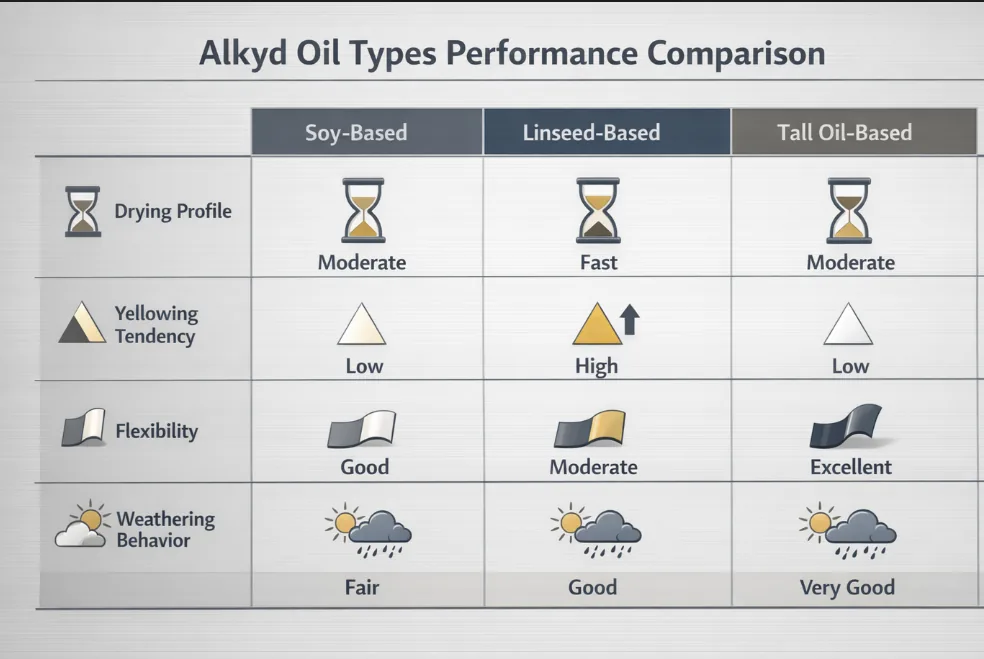
1. What oil type actually changes in alkyd systems
Oil type affects the fatty-acid profile, which can influence:
- Oxidative drying behavior
- Color stability and yellowing tendency
- Film flexibility and toughness
- Weathering and moisture response
These effects are real, but they are not independent of the rest of the formulation.
2. Soy, linseed, and tall oil: practical differences
Soy-based alkyds
- Generally balanced performance
- Widely used in decorative and general-purpose systems
- Often chosen for practical cost-performance balance
Linseed-based alkyds
- Strong oxidative reactivity and good cure response
- Can provide strong film development in appropriate systems
- May require tighter control of yellowing-sensitive applications
Tall-oil-based alkyds
- Common in industrial and maintenance segments
- Can offer robust toughness and cost competitiveness
- Behavior depends strongly on refining quality and modification route
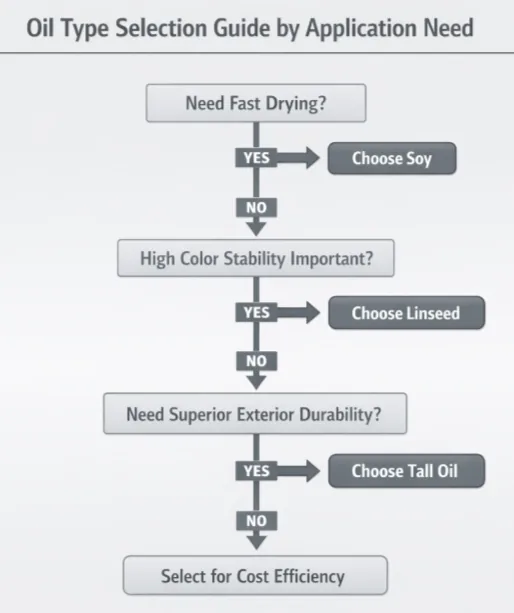
3. Which oil-type claims matter most for selection
Prioritize oil-type effects when your coating has strict requirements for:
- Dry-time window in ambient cure
- Color retention in light shades
- Exterior weathering durability
- Flexibility under substrate movement
If these are not critical constraints, oil type is often a secondary optimization lever.
4. What usually matters more than oil type
In many projects, these variables have larger impact than oil source:
- Oil length (long, medium, short)
- Resin molecular architecture and modification level
- Drier package type and dosage
- Solvent balance and film thickness
- Curing environment (temperature, humidity, airflow)
This is why two alkyds with the same oil source can perform very differently in production.
5. How to evaluate oil type without guesswork
Use a controlled side-by-side test protocol:
- Keep pigment volume concentration and solvent package fixed
- Compare dry profile and hardness build over time
- Measure gloss retention and yellowing tendency
- Check flexibility, adhesion, and water resistance
- Select the system with best total performance at target cost
This prevents specification based on assumptions and improves repeatability.
Final takeaway
Soy, linseed, and tall oil choices can matter, but they are not standalone quality rankings. Oil type is one input in a larger system that includes oil length, resin design, drier chemistry, and curing reality. The best choice is the one that validates on your target panel tests and process conditions.
View Alkyd Resin Families Request Oil-Type Comparison
FAQ: Choosing Alkyd Oil Types
Is linseed always better than soy for drying speed?
Not always. Drying depends on full resin design and drier balance, not oil source alone.
Does tall oil mean lower quality?
No. Tall-oil alkyds can perform well when resin architecture and processing quality are well controlled.
When should oil type be a primary selection factor?
When you have strict dry-time, yellowing, weathering, or flexibility requirements that panel testing confirms are oil-type sensitive.
Can two soy-based alkyds perform very differently?
Yes. Oil length, molecular structure, modifiers, and drier response can create major performance differences.
What is the safest procurement approach?
Use side-by-side application testing and full specification review, then select on measured performance and total cost.