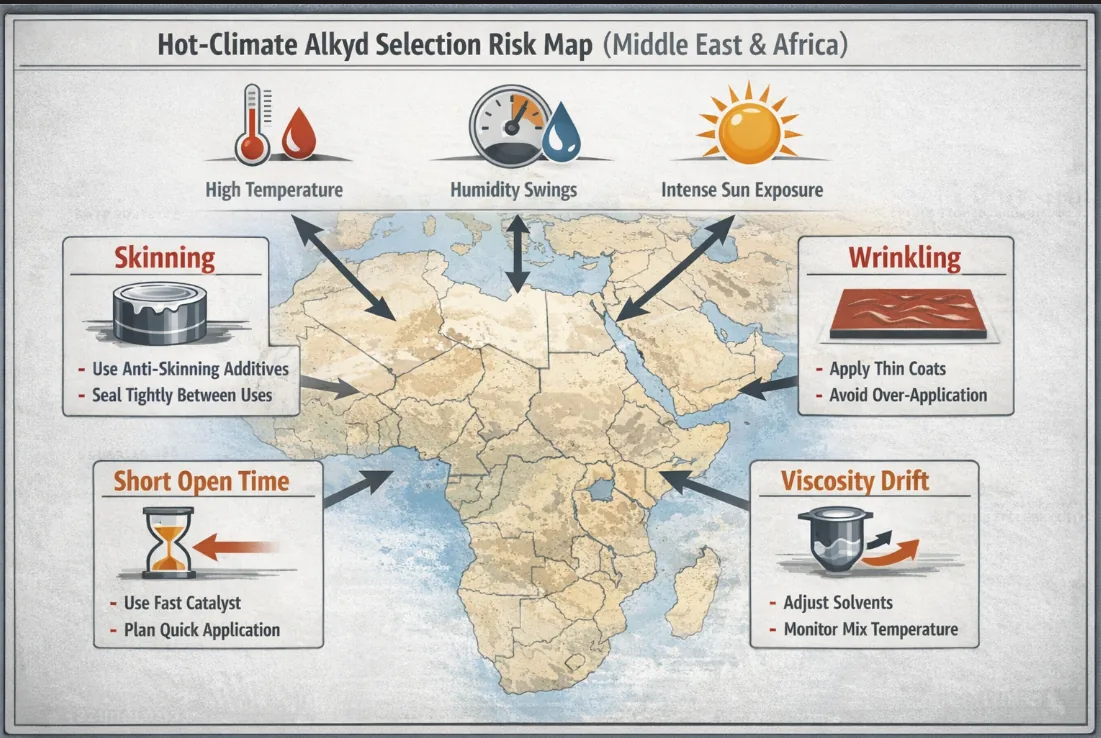
1. Define the real heat exposure profile
Hot-climate selection starts with real operating conditions, not average weather data.
Confirm:
- Typical daytime and nighttime temperature ranges
- Relative humidity swings
- Application conditions (shade, direct sun, enclosed workshops)
- Storage and transport exposure duration
This profile determines whether the coating can maintain workable open time and predictable cure.
2. Drying behavior in high-temperature markets
Higher temperature can improve solvent flash-off but also increases failure risk.
Common hot-climate issues:
- Surface skinning before full film leveling
- Solvent entrapment and wrinkling
- Reduced open time causing application marks
- Faster viscosity drift during use
Resin, solvent package, and drier set must be tuned together for heat conditions.
3. Oil length and modification strategy for heat
Medium oil alkyds
- Often the practical baseline for hot climates
- Balance handling speed and film integrity
Long oil alkyds
- Better flow and flexibility
- Can become too slow or skin-prone if drier and solvent package are not balanced
Modified alkyds (including urethane-modified grades)
- Useful where higher hardness and cleaner resistance are needed
- Require validation for flow and recoat behavior under heat stress
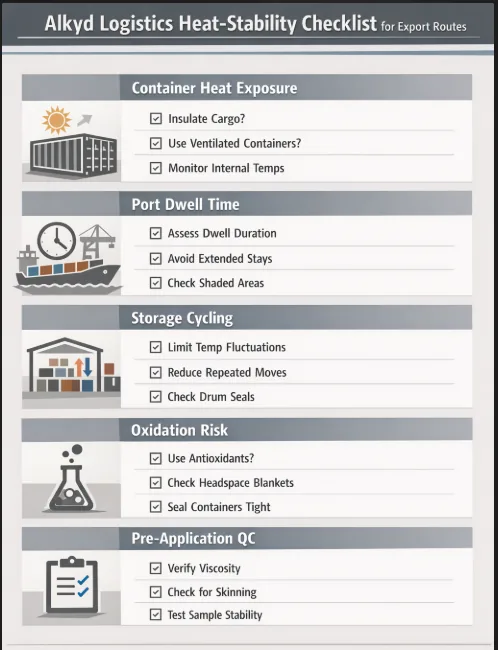
4. Storage and logistics are part of resin performance
For Middle East and Africa supply routes, long transit and port dwell times are common.
Selection must account for:
- Heat exposure in containerized transport
- Oxidation risk during storage
- Drum/IBC temperature cycling
- Shelf-life margin before site application
A technically suitable resin can still fail commercially if logistics stability is not considered.
5. Quality control checks for hot-climate approval
Before rollout, validate:
- Dry profile at representative high temperature/humidity
- Flow, leveling, and gloss after heat-exposed storage
- Skinning tendency and in-can stability
- Adhesion and flexibility after accelerated conditioning
- Recoat window tolerance under field-like conditions
This step reduces complaint risk in export-driven supply chains.
Final takeaway
Selecting alkyd resins for Middle East and Africa applications requires climate-specific engineering. The right resin is one that balances open time, dry profile, and long-route stability under real temperature stress. Hot-climate reliability comes from formulation and logistics working together.
Explore Alkyd Resin Portfolio Request Hot-Climate Grade Support
FAQ: Hot-Climate Alkyd Selection
Do alkyds always dry faster in hotter climates?
Not always in a useful way. Heat can speed surface dry but also increase skinning, wrinkling, and leveling defects if formulation is not adjusted.
Which alkyd family is usually safest for hot-climate ambient cure?
Medium oil systems are often the most practical starting point, then tuned with solvent and drier design for local conditions.
How does logistics affect coating performance in hot markets?
Extended high-temperature storage and transport can shift viscosity and oxidation state, reducing predictable application behavior on-site.
Should I increase drier dosage to compensate for climate variation?
Only with controlled testing. Over-dosing driers can cause skinning and wrinkling, especially in high ambient heat.
What is the most important pre-approval test?
Field-simulated panel testing after heat-exposed storage is usually the highest-value gate before full commercial rollout.