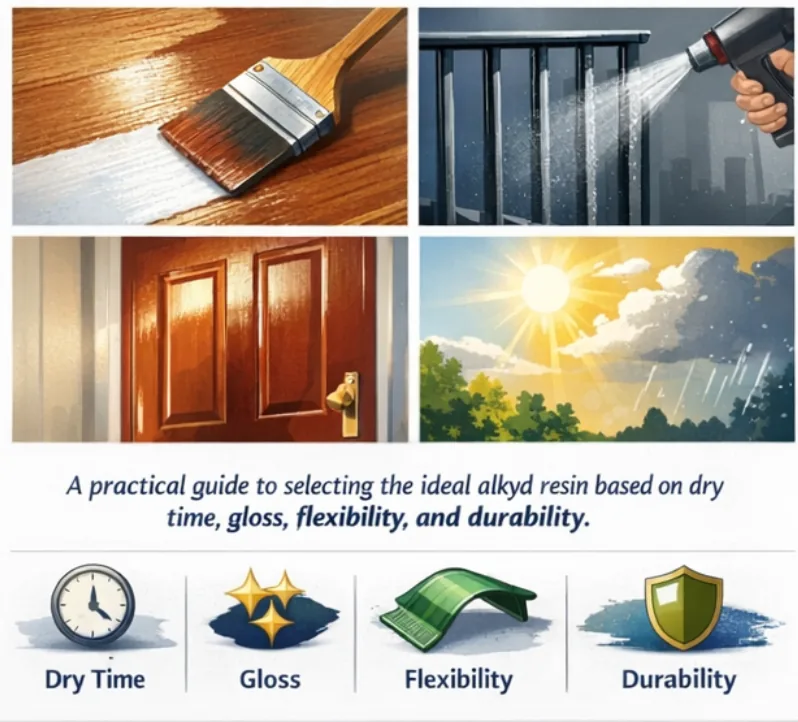
1. Define the decorative coating target before choosing resin
For decorative systems, the resin must serve appearance and handling together. Confirm these inputs first:
- Substrate: wood, metal, masonry, or mixed surfaces
- Finish target: matte, satin, semi-gloss, or high gloss
- Application method: brush, roller, or spray
- Service conditions: interior, exterior, humidity, UV, and cleaning frequency
Without this scope, resin selection becomes guesswork and reformulation cycles increase.
2. Choose oil length based on film behavior, not habit
Oil length is still the primary selection dial.
Long oil alkyds
- Better flow and leveling
- Higher flexibility on moving substrates
- Slower dry and lower early hardness
Best fit: decorative enamels where brushability and appearance are prioritized.
Medium oil alkyds
- Better balance between dry speed and film toughness
- Stronger hardness build than long oil
- Practical for both interior and exterior decorative topcoats
Best fit: general-purpose decorative coatings with moderate throughput pressure.
Short oil alkyds
- High hardness potential
- Faster response in forced dry systems
- Limited ambient air-dry suitability
Best fit: only when production has controlled bake or force-dry capability.
3. Decide when urethane-modified alkyds are justified
Standard alkyds are often enough for price-sensitive decorative grades. Use urethane-modified alkyds when the coating must tolerate:
- Higher block resistance
- Better abrasion resistance
- Better chemical or cleaner resistance
- Faster return-to-service handling
Do not add modification cost unless the end-use actually demands it.
4. Match dry-time profile to the production model
Dry performance should be engineered to throughput, not just final film properties.
Check at minimum:
- Dust-free time
- Tack-free time
- Recoat window
- Through-dry time at site temperature and humidity
Plants with fast line turnover usually need medium-oil or modified systems. Contractor-applied decorative paints may prefer longer open time for leveling and brush marks control.
5. Align solvent and drier package with the resin family
Many decorative defects come from incompatibility between resin architecture and auxiliary package.
Common failure patterns:
- Solvent mismatch causes haze, poor flow, or viscosity drift
- Over-drier dosing causes wrinkling and skinning
- Under-drier dosing causes slow cure and dust pickup
Resin selection and drying package must be validated together.
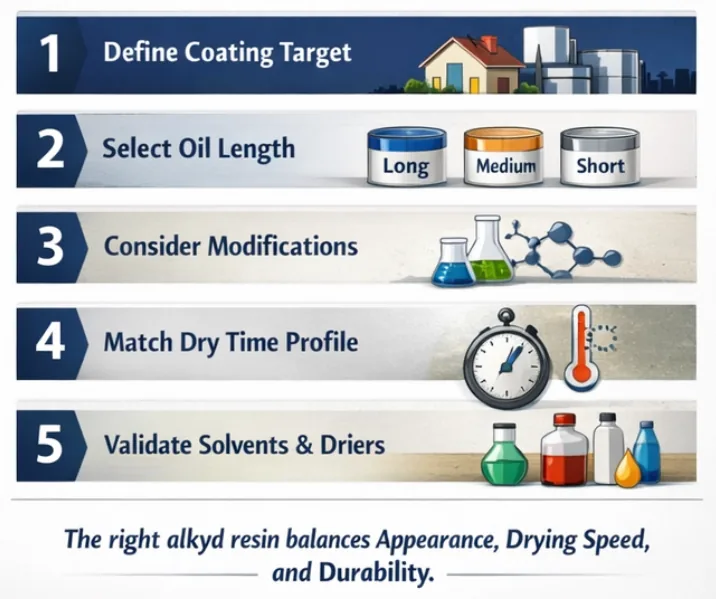
6. Use a practical selection checklist
Before locking the grade, verify:
- Target substrate and movement profile are defined
- Required dry times match process and climate reality
- Hardness-flexibility balance fits the end-use
- Gloss and leveling targets are repeatable at scale
- Solvent and drier package are validated in pilot batches
This five-point check removes most avoidable decorative reformulation loops.
Final takeaway
The right decorative alkyd is the one that balances appearance, handling speed, and service durability for your real operating conditions. Oil length should be selected first, then tuned with modification level, solvent strength, and drier package.
A structured selection process cuts defects, shortens scale-up time, and improves customer consistency.
View Alkyd Resin Families Request Grade Recommendation
FAQ: Decorative Alkyd Resin Selection
What oil length is best for decorative enamels?
Most decorative enamel systems use long or medium oil alkyds, depending on whether leveling/flexibility or faster hardness build is the higher priority.
When should I use urethane-modified alkyds in decorative coatings?
Use them when you need higher block resistance, abrasion resistance, or cleaner resistance than standard alkyds can deliver at your target dry schedule.
Why does my decorative alkyd stay tacky for too long?
Typical causes are slow-curing oil length, under-dosed driers, high film thickness, poor airflow, or high humidity during cure.
Can I speed drying without changing the resin?
You can optimize driers, solvent evaporation profile, airflow, and film thickness, but intrinsic oil length still sets a practical lower limit for ambient cure speed.
What is the most common selection mistake?
Choosing resin based only on target hardness while ignoring application method and climate. This usually creates recoat delays, wrinkling, or poor leveling.