Oil length is the single most influential structural parameter in alkyd resin design. It governs how an alkyd dries, how flexible or brittle the final film becomes, and how hard or durable the coating will be in service. Despite its importance, oil length is still widely misunderstood in procurement and formulation decisions—especially in emerging markets where alkyds remain dominant.
This article explains, in practical terms, how oil length directly affects drying time, flexibility, and hardness, why these trade-offs matter commercially, and how incorrect selection leads to formulation failures, production delays, and field complaints.

1. What oil length actually means in alkyd resins
Oil length refers to the percentage of fatty acids or drying oils incorporated into the alkyd polymer backbone. It is not a marketing label; it is a structural variable that determines how the polymer behaves during application and curing.
Typical classification
- Long oil alkyds: >60% fatty acids
- Medium oil alkyds: ~40–60% fatty acids
- Short oil alkyds: <40% fatty acids
Changing oil length alters
- Polymer mobility
- Crosslink density after curing
- Solvent compatibility
- Drying mechanism efficiency
Because alkyd buyers must balance flexibility versus hardness and drying speed versus durability, oil length sits at the center of nearly every technical trade-off in alkyd selection.
2. Oil length and drying time: why more oil dries slower
Alkyds cure through autoxidation. Oxygen from the air reacts with unsaturated bonds in the fatty acid chains, forming radicals that crosslink the polymer network. This process is catalyzed by metal driers.
Long oil alkyds contain more fatty acid chains and fewer rigid polyester segments. While this improves flexibility, it reduces the density of crosslinking sites per unit volume. As a result:
- Oxygen diffusion is slower
- Crosslink formation takes longer
- Full cure is delayed
Practically:
- Long oil alkyds dry slower
- They remain tacky for longer periods
- They are more sensitive to dust contamination during cure
Short oil alkyds behave in the opposite way. With fewer fatty acids and more rigid polyester structure:
- Crosslink density increases rapidly
- Films harden quickly
- Air-dry performance is poor unless assisted
This is why short oil alkyds typically require baking or force drying and why they are commonly used in industrial and OEM coatings rather than decorative air-dry systems.
Common buyer mistake: choosing long oil alkyds for fast-throughput lines, leading to bottlenecks, delayed handling, and inconsistent film properties.
3. Oil length and flexibility: why long oil bends and short oil cracks
Flexibility depends on how freely polymer chains can move after curing.
Long oil alkyds
- Longer, more flexible fatty acid segments
- Lower internal stress in the film
- Better ability to absorb substrate movement without cracking
Ideal for: wood coatings, exterior decorative paints, metal surfaces exposed to thermal cycling.
Short oil alkyds
- Shorter oil segments and higher polyester content
- Rigid, tightly crosslinked films
- Higher internal stress; prone to brittleness on flexible substrates
When misapplied, short oil alkyds lead to microcracking and premature failure. Medium oil alkyds offer a practical balance: moderate flexibility with improved hardness and faster drying than long oil systems.
4. Oil length and hardness: the durability trade-off
Hardness increases as oil length decreases.
Short oil alkyds
- Cure into hard, abrasion-resistant films
- Offer superior block resistance
- Perform well under mechanical stress
Best for: industrial metal coatings, machinery finishes, high-build baked enamels.
Long oil alkyds
- Produce softer films
- Sacrifice hardness for toughness and elongation
- More prone to surface marking
Excess hardness without flexibility leads to cracking and early failure—especially in climates with wide temperature swings. Oil length defines not just hardness, but the balance between hardness and durability.
5. Solvent compatibility: the hidden oil-length failure point
- Long oil alkyds are generally soluble in aliphatic solvents (e.g., mineral spirits).
- Short oil alkyds usually require stronger aromatic solvents to dissolve properly.
Mismatching oil length and solvent system causes phase separation, incomplete dissolution, and application defects (poor leveling, haze, viscosity drift). These are often misdiagnosed as “bad resin quality” when the root cause is incorrect oil-length selection.
6. Oil length, driers, and the drying-system trap
Drying speed is the interaction of oil length and the drier package. Without metal driers, alkyd films may take months to cure. With incorrect dosing:
- Over-drying → surface skinning, solvent entrapment, wrinkling
- Under-drying → tackiness and contamination
Long oil alkyds are especially sensitive because their slower intrinsic cure magnifies formulation errors. The phase-out of cobalt driers complicates this; alternatives (manganese, iron) often need higher dosages and careful balancing, particularly in long-oil systems.
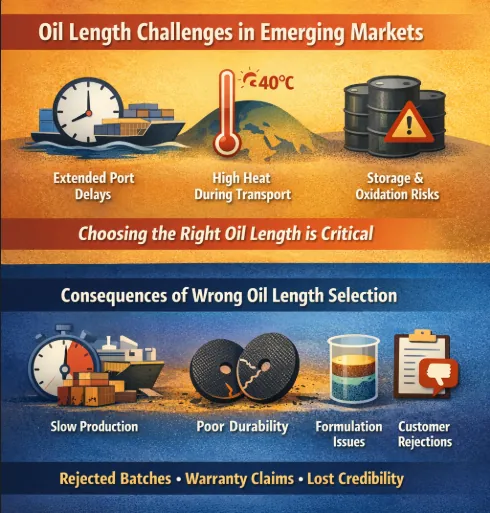
7. Practical consequences of wrong oil-length selection
- Drying-time mismatches slow production and throughput
- Flexibility errors cause cracking and field failures
- Hardness mismatches lead to either poor abrasion resistance or brittleness
- Solvent incompatibility creates formulation instability
- Drier misbehavior produces visible film defects
Commercially, these translate to rejected batches, customer complaints, warranty claims, and reputational damage. Oil length is a risk management variable, not a minor spec line.
8. Why oil length matters more in emerging markets
In Africa, the Middle East, and Eastern Europe, oil-length selection is amplified by:
- Extended port dwell times
- High ambient temperatures during transport
- Storage conditions that accelerate oxidation
- Limited reformulation flexibility on-site
Long oil alkyds, while forgiving in application, are more vulnerable to heat-induced degradation during transit. Short oil alkyds, while stable, demand stricter solvent and curing control. Successful suppliers align oil length with both application and logistics reality.
Conclusion
Oil length directly determines drying time, flexibility, and hardness in alkyd coatings. It is the foundational decision that shapes performance, formulation complexity, and commercial risk.
Long oil alkyds deliver flexibility and toughness at the cost of slower drying. Short oil alkyds provide hardness and fast cure but demand precise solvents and curing conditions. Medium oil alkyds bridge the gap but still require informed selection.
In alkyd procurement, oil length is not a specification line item—it is the structural logic of the resin. Buyers who understand this make faster decisions, avoid costly failures, and build more resilient formulations.
FAQ: Oil Length, Drying, Flexibility, and Hardness
Why do long oil alkyds dry slower than short oil alkyds?
Higher oil content lowers crosslink density and slows oxygen diffusion, so autoxidation takes longer. Short oil alkyds have fewer fatty acids and crosslink faster, especially with heat.
Can I speed up a long oil alkyd without changing the resin?
You can optimize drier type/dose, film thickness, and airflow, but there is a ceiling: the intrinsic oil length still sets the baseline curing rate.
Which oil length should I choose for flexible substrates?
Use long oil (or upper-medium) alkyds for wood or substrates that move; short oil systems are too rigid and risk cracking.
Why won’t my short oil alkyd air-dry properly?
Short oils are designed for bake/force-dry. Without heat and the right drier balance, they remain under-cured and brittle.
How does solvent choice relate to oil length?
Long oils dissolve in aliphatic solvents; short oils often need aromatic strength. Mismatching solvent strength causes haze, phase separation, and poor leveling.
Do alternative driers (non-cobalt) change oil-length selection?
They don’t change the needed oil length, but they may require dose tweaks—especially for slow-curing long oils—to hit target dry times without wrinkling or under-cure.